The Quiet Wall
A Guide to Choosing Lower-Load Art for Calmer Spaces
The Quiet Wall is a research-informed guide from Recalibrate & Exhale about choosing lower-load art for calmer spaces. It explains why some rooms can look beautiful but still feel visually demanding, and how carefully selected artwork can give the eyes somewhere softer and steadier to land.
The guide introduces the idea of visual nervous system load — the subtle demand a space places on attention, scanning and sensory processing. It explores how contrast, visual clutter, symbolic intensity and competing focal points can keep the brain working in the background, and how lower-load, nature-inspired art may help create spaces that feel clearer, softer and easier to inhabit.
It includes practical guidance for choosing calming artwork, reducing unnecessary visual demand, creating one visual anchor, and applying these ideas in bedrooms, therapy rooms, waiting areas, workspaces and living spaces.
The free guide teaches how to choose art that asks less of the eyes and helps your space feel more settled.
Why I created this guide
I created this guide because many people sense that their environment affects them, but they have not always been given the language to explain why.
The Quiet Wall is a research-informed guide to choosing calmer, nature-inspired artwork and shaping visual environments with less unnecessary demand.
Not all art reduces visual load. Some artwork is designed to stimulate, provoke, challenge or energise. That can be valuable in the right context. But in bedrooms, therapy rooms, waiting areas, recovery spaces and quiet work areas, the goal is often different. In these spaces, the question becomes: what visual input is this room repeatedly asking my brain and body to process?
A room can look beautiful and still feel visually demanding. It can be carefully decorated and still ask the eyes, attention and body to keep working. For people who already carry a high cognitive or emotional load, this background visual demand can matter.
This guide explores how lower-load artwork — art with softer contrast, clearer composition, lower symbolic intensity and more visual breathing space — may help create rooms that feel calmer, easier to inhabit and more supportive of settling.
As a psychologist and artist, I am interested in the quieter relationship between art, attention and the nervous system. Not in the sense that artwork is therapy or a medical treatment, but in the sense that our surroundings can either add to the load we carry or help create conditions that feel softer, clearer and easier to inhabit.
Recalibrate & Exhale grew from this idea: that art can be more than something that fills a wall. It can become a resting place for the eyes. It can reduce visual noise. It can help a room feel less like another demand and more like a place to exhale.
This guide brings together research, design principles and practical reflection to help you choose art and shape spaces with greater intention.
1. A different way to think about your walls
Most of us were taught to think about wall art as decoration: Does it match the couch? Does it fill the blank space? Does it look stylish? Those questions are not wrong, but they are incomplete. A more useful question may be: What does this image ask of my attention?
Some images pull the mind into interpretation. They use strong contrast, complex symbolism, intense emotion, sharp geometry or visual surprise. In the right context, this can be powerful and exciting. In a gallery, a creative studio or a bold hospitality space, high-impact art can wake up the room. But in bedrooms, therapy rooms, waiting rooms, recovery spaces and quiet work areas, the same intensity may become visual noise.
Lower-load art works differently. It tends to be slower, softer and more predictable. It may use gentle tonal transitions, nature-based forms, clear compositional breathing space and low symbolic demand. Instead of asking the viewer to solve the image, it allows the body to settle beside it.
2. What the research says about viewing art
A growing body of research links arts and cultural engagement with wellbeing. The World Health Organization’s 2019 scoping review synthesized evidence from more than 3,000 studies and concluded that the arts can play a role in health promotion, prevention and the management of illness. That evidence includes many forms of art engagement, from creating art to attending cultural events, so it should not be reduced to a simple claim that one print will improve health. Still, it provides an important foundation: arts experiences belong in serious conversations about wellbeing.
More specifically, a 2025 systematic review on viewing visual art found that receptive art viewing — looking at art rather than making it — is associated with wellbeing benefits. The review also suggests that benefits may arise through several pathways: emotional response, pleasure, meaning-making, absorption, self-reflection and social connection. In everyday life, these pathways may look quite ordinary. An image may help a person feel less reactive, less irritated or less mentally crowded. It may offer a small moment of pleasure, recognition or steadiness. It may invite the mind to wander gently rather than keep scanning for what needs to be fixed. It may support reflection, memory or connection to place. In a shared space, artwork may also become a quiet point of conversation or orientation.
This matters for R&E because it supports the idea that art is not passive decoration. It is an experience between viewer, image and place. The same artwork will not affect every person in the same way, but carefully chosen art can help shape the emotional and attentional atmosphere of a room.
Digital viewing also has relevance. Studies of online art and culture presentations have found short-term improvements in mood, state anxiety and subjective wellbeing for some viewers. This does not mean digital art is identical to viewing original work in a gallery. Context, scale, materiality and personal relevance all matter. But it does support a sensible claim: carefully chosen digital artwork can still participate in a person’s wellbeing environment once printed and placed intentionally.
3. What the body may be responding to
The body responds to environments through multiple systems at once: attention, emotion, memory, movement, light, sound, social meaning and perceived safety. Art can influence several of these channels simultaneously.
A 2025 King’s College London and Art Fund physiological study reported that adults viewing original artworks in a gallery showed reductions in cortisol and inflammatory markers after a short viewing session, while a reproduction-viewing control group did not show the same pattern. This finding is promising because it measured biological markers, not only self-report. However, the study involved a small sample and the publicly available report should be described as emerging evidence rather than settled clinical proof.
The practical takeaway is modest but useful: art can be emotionally and physiologically engaging. It may help some people shift state. Visual art can be one element of a calmer sensory environment, especially when selected with attention to visual complexity, emotional tone and context.
4. The nervous-system lens: visual load, attention and restoration
Our visual system is not a camera calmly recording the world. It is an active filtering system. When multiple stimuli are present at once, they compete for neural representation. Attention helps resolve that competition, but attention is metabolically and cognitively costly. This is one reason visually busy environments can feel tiring: the brain is continually sorting what matters from what does not.
This is where “visual nervous system load” becomes a useful everyday phrase. It brings together three overlapping ideas:
· Visual complexity: how much detail, contrast, pattern, colour and movement the eyes must process.
· Symbolic load: how much emotional meaning, narrative ambiguity or social threat the image asks the viewer to interpret.
· Attentional demand: how strongly the image pulls attention away from rest, conversation, reflection or task focus.
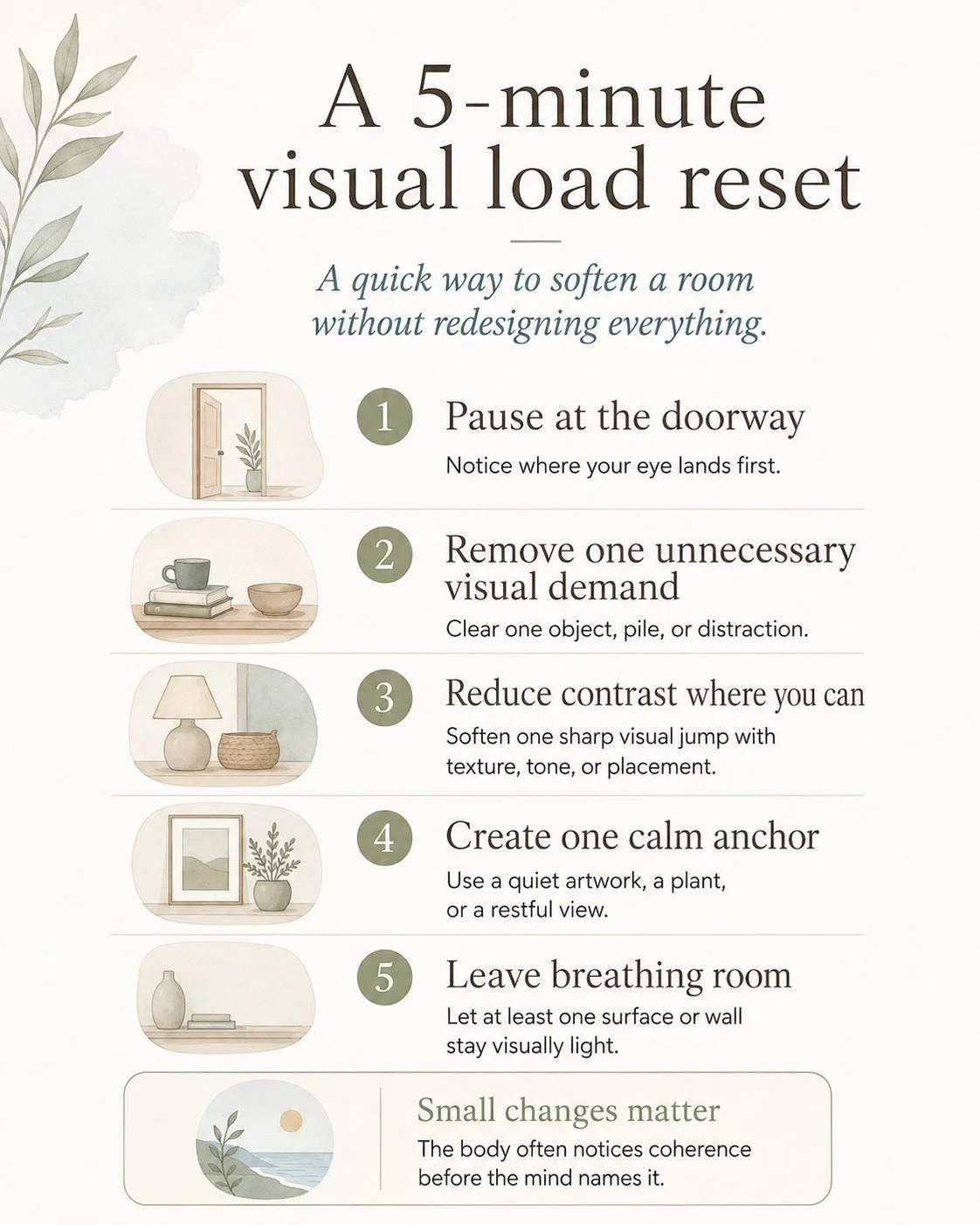
In a calming room, the goal is not emptiness. The goal is coherent, supportive input.
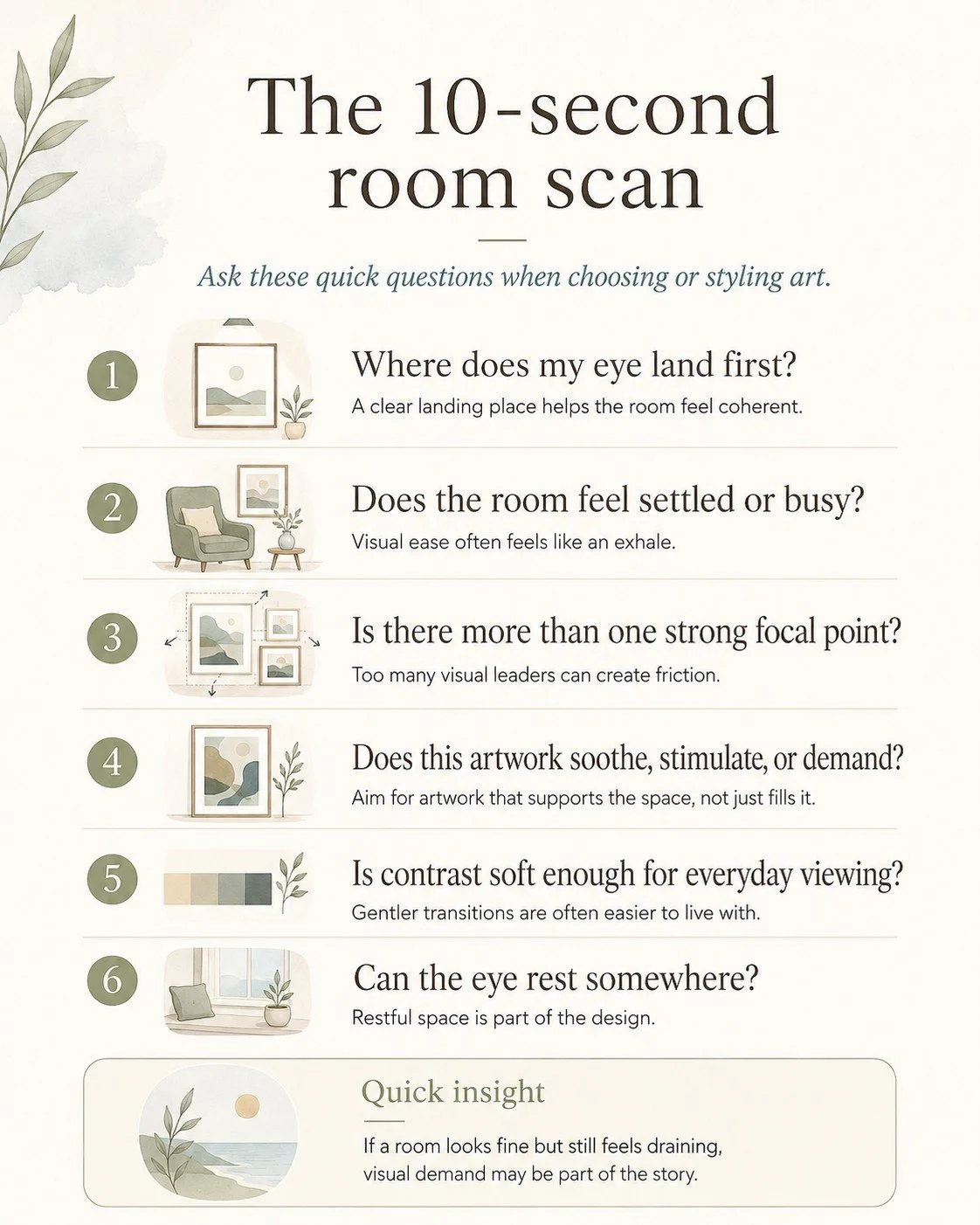
A quiet artwork can become a visual anchor. This means it gives the eyes somewhere clear and steady to land. Instead of the viewer’s attention bouncing between objects, colours, patterns and competing details, the artwork offers one gentle point of orientation.
A good visual anchor does not need to be dramatic. In fact, in a calming space, it often works best when it is quiet. It may use soft contrast, a clear horizon, a simple composition, a familiar natural form, or a sense of spaciousness. The image is present enough to help organise the room, but not so forceful that it takes over.
This is why lower-load art is not the same as bland art. The artwork still needs to feel human. It can hold memory, atmosphere, place or beauty. But it should do so in a way that helps the room feel more settled, not more demanding.
5. Why nature-inspired art matters
Nature appears again and again in research about calming and restorative spaces.
This makes sense. Many people already know the feeling of looking at the ocean, sitting under trees, watching clouds move, or seeing light shift across a garden. The body often responds before we have words for it. Breathing is given the opportunity to slow, the eyes to soften. Attention may feel less forced. The mind may have a little more space to wander and daydream.
Research suggests that contact with nature can support mental wellbeing, stress recovery, attention and overall health. Real nature is usually the richest experience because it involves more than sight. It includes sound, movement, air, temperature, smell and the feeling of being physically present in a living environment.
But interior spaces matter too. We cannot always step outside, especially in workspaces, therapy rooms, waiting rooms, bedrooms or places where people spend long hours indoors. This is where represented nature can help. Images of landscapes, water, trees, gardens, skies and natural forms may offer a small version of that restorative experience.
A nature-inspired artwork is not the same as standing in a forest or walking beside the sea. But it can still give the eyes something familiar, organised and easier to rest on. It can bring a quiet reminder of the natural world into a room and help the space feel less hard, less busy and more breathable.
In fact, a 2025 review of nature imagery and visual art in healthcare contexts found that nature imagery showed comparatively consistent evidence for reducing stress, anxiety and pain and improving patient satisfaction. The evidence for non-nature visual art is more mixed, which is useful rather than discouraging: it tells us that subject matter, style and context matter.
This gives R&E a clear and responsible position. Nature-inspired art is not calming simply because it is pretty. It may be calming because it borrows from environments the nervous system already knows how to read: horizons, water, trees, sky, soft repetition, gentle depth, organic forms and balanced complexity.
Calming art is not blank. It is legible without being demanding.
6. What lower-load art often has in common
The following design qualities can help reduce unnecessary visual demand:
Soft contrast
Why it matters: The eye can move without sharp visual interruption.
Gentle colour temperature
Why it matters: Muted coastal, botanical or earth-based palettes are less likely to feel visually urgent.
Clear breathing space
Why it matters: Open sky, water, field or quiet negative space gives attention somewhere to rest.
Low symbolic ambiguity
Why it matters: The image does not ask the viewer to decode conflict, threat, irony or unresolved human drama.
Organic repetition
Why it matters: Natural rhythms such as grass, waves, leaves or clouds provide interest without visual aggression.
Balanced focal point
Why it matters: A soft anchor gives orientation without dominating the room.
Emotional neutrality
Why it matters: The piece can support many moods rather than forcing one strong emotional interpretation.
Resources behind this guide
This guide draws on research from arts and health, visual art viewing, nature exposure, healthcare design, attention science and digital art studies. The evidence does not suggest that artwork is therapy, medical treatment or a guaranteed way to change health outcomes. Instead, it supports a more careful idea: what we look at can influence attention, emotion, meaning, stress recovery and the felt atmosphere of a space. 15
The following sources informed the guide.
Arts, health and wellbeing
The World Health Organization’s scoping review on arts and health provides a broad foundation for understanding the role of arts engagement in health promotion, prevention and illness management. This source is used as an umbrella reference for the wider relationship between arts participation, cultural engagement and wellbeing.
Trupp and colleagues’ 2025 systematic review focuses more specifically on viewing visual art. It suggests that looking at art may support wellbeing through pathways such as emotional response, pleasure, meaning-making, absorption, self-reflection and social connection. This is one of the key sources behind the guide’s position that viewing art can be an active experience rather than passive decoration.
Digital and online art viewing
Studies by Trupp and colleagues in 2022 and 2023 explored brief online art-viewing experiences. These studies are relevant to Recalibrate & Exhale because R&E offers digital-download artwork. The findings suggest that short digital art experiences may improve mood or reduce state anxiety for some people, although responses vary and results should not be treated as universal.
Nature imagery and healthcare spaces
Cardillo and Chatterjee’s 2025 review of nature imagery and visual art in healthcare contexts is especially relevant to R&E’s nature-inspired positioning. Their review found comparatively consistent evidence that nature imagery in healthcare settings may support outcomes such as reduced stress, reduced anxiety, reduced pain and improved satisfaction.
Foster and colleagues’ 2025 healthcare scoping review also informed this guide. It examined how visual artwork in healthcare settings may affect patients, staff and visitors, including outcomes related to wellbeing, wellness, belonging and the experience of place. This is particularly relevant for therapy rooms, consultation rooms, waiting areas and other professional spaces where the visual environment matters.
Visual attention and visual load
McMains and Kastner’s work on visual attention helps support the guide’s use of the term visual load. Their research discusses how multiple stimuli compete for neural representation in the visual cortex. This does not prove that a specific artwork will change a person’s stress level, but it does provide a useful scientific basis for understanding why crowded, high-contrast or visually complex environments may ask more of attention.
Nature exposure and represented nature
Research on real, digital and video-based nature exposure informed the guide’s discussion of nature-inspired art. Real nature is generally the richest form of exposure because it involves sight, sound, movement, air, smell and physical presence. However, represented nature — including images, videos and digital nature — may still offer short-term restorative effects for some people. This supports the idea that nature imagery inside a room can be meaningful, while still recognising that it is not the same as being outdoors.
Emerging physiological evidence
A 2025 King’s College London and Art Fund report by Perez, Worrell and colleagues explored the physiological effects of viewing original artworks in a gallery setting. The report found associations with reduced cortisol and inflammatory markers in a small sample. These findings are promising, but they should be treated carefully because the report was public-facing and, at the time of writing, not yet peer-reviewed. For that reason, this guide refers to this area as emerging evidence rather than making direct physiological claims about R&E artwork. 16
How to read the evidence
The research behind this guide is encouraging, but it does not mean that every person will respond to every artwork in the same way. Responses to art are shaped by personal history, culture, memory, sensory preferences, neurodivergence, the room itself and the emotional state of the viewer.
For this reason, Recalibrate & Exhale uses careful language. The guide speaks about artwork that may support softer visual environments, may reduce visual demand, and may help create conditions for settling. It does not claim that artwork treats, cures or guarantees mental or physical health outcomes.
What the evidence supports
Viewing art and wellbeing: Reviews indicate that viewing visual art can support aspects of mood, meaning and subjective wellbeing. Effects vary according to the person, artwork, setting and type of engagement.
Nature imagery and restorative environments: Nature exposure and nature-based imagery are repeatedly associated with restorative outcomes. Evidence from healthcare settings is especially supportive of calm natural scenes, although study quality and outcomes remain variable.
Digital art viewing: Brief online encounters with art have produced short-term improvements in some measures of mood, state anxiety and wellbeing, suggesting that beneficial engagement is not limited to museums or original artworks.
Attention and visual demand: Visual environments compete for limited attention. Contrast, detail, pattern, emotional intensity and competing focal points can increase processing demand; coherence and visual breathing space may make a setting easier to navigate.
How to interpret this guide
The phrase “visual nervous system load” is an accessible Recalibrate & Exhale framework, not a formal diagnosis or validated clinical measure. It describes the combined perceptual, attentional and interpretive demand that a visual environment may place on a person.
The recommendations in this guide are design principles rather than treatment claims. Individual responses to art differ, and personal meaning, culture, neurodiversity, health, context and preference all influence whether an image feels settling, stimulating or demanding.
Evidence status: Peer-reviewed reviews and studies were prioritised. The King’s College London/Art Fund physiological findings discussed earlier are promising but were publicly reported before peer-reviewed publication and should be treated as emerging evidence.
Evidence last reviewed: June 2026.
References
Cardillo, E. R., & Chatterjee, A. (2025). Benefits of nature imagery and visual art in healthcare contexts: A view from empirical aesthetics. Buildings, 15(7), 1027. https://doi.org/10.3390/buildings15071027
Fancourt, D., & Finn, S. (2019). What is the evidence on the role of the arts in improving health and well-being? A scoping review. WHO Regional Office for Europe. ISBN 978-92-890-5455-3.
Jimenez, M. P., DeVille, N. V., Elliott, E. G., Schiff, J. E., Wilt, G. E., Hart, J. E., & James, P. (2021). Associations between nature exposure and health: A review of the evidence. International Journal of Environmental Research and Public Health, 18(9), 4790. https://doi.org/10.3390/ijerph18094790
McMains, S., & Kastner, S. (2011). Interactions of top-down and bottom-up mechanisms in human visual cortex. Journal of Neuroscience, 31(2), 587-597. https://doi.org/10.1523/JNEUROSCI.3766-10.2011
Trupp, M. D., Bignardi, G., Chana, K., Specker, E., & Pelowski, M. (2022). Can a brief interaction with online, digital art improve wellbeing? A comparative study of the impact of online art and culture presentations on mood, state-anxiety, subjective wellbeing, and loneliness. Frontiers in Psychology, 13, 782033. https://doi.org/10.3389/fpsyg.2022.782033
Trupp, M. D., Howlin, C., Fekete, A., Kutsche, J., Fingerhut, J., & Pelowski, M. (2025). The impact of viewing art on well-being: A systematic review of the evidence base and suggested mechanisms. The Journal of Positive Psychology. Advance online publication. https://doi.org/10.1080/17439760.2025.2481041
Trupp, M. D., et al. (2023). Who benefits from online art viewing, and how: The role of pleasure, meaningfulness and trait aesthetic responsiveness. Computers in Human Behavior, 145, 107764. https://doi.org/10.1016/j.chb.2023.107764
Perez, P. F., Worrell, C., et al. (2025). The physiological impact of viewing original artworks versus reproductions: A comparative study. King’s College London and Art Fund. Emerging evidence; peer-reviewed publication status should be checked before final release.
Source note: This is a selective reference list supporting the principal claims in the guide, rather than an exhaustive review of the arts-and-health literature.